Lorem ipsum dolor
Lorem ipsum dolor sit amet
Welcome to the Psychosocial Risk Assessment Hub
Learn how running a psychosocial risk assessment can benefit your organisation

Learn how our state-of-the-art psychosocial risk assessment can enhance your health and safety practice and help your clients fully comply with their legal duty of care.
Learn how our psychosocial risk assessment tool can help you move beyond engagement surveys to significantly improve engagement, retention and performance.
Psychosocial hazards are conditions present in a work situation that are directly related to the way work is organised, the tasks being performed, the work environment, and the interactions that take place. They can affect not only physical, psychological, and social wellbeing, but also work performance.
By identifying and addressing psychosocial risks, you create the conditions for people to thrive, and for your organisation to perform at its best. Here’s how our assessment can make a difference:

Proactively identifying and addressing psychosocial hazards helps reduce legal, financial and reputational risk.

Our assessment supports your ability to show measurable progress on employee wellbeing, ethical leadership, and social impact.

Get evidence-based insight to understand what’s holding people back to improve commitment across your organisation.

Build a culture that encourages people to stay, grow, and thrive, reducing turnover and protecting the talent that drives your business forward.

Identify the barriers to peak performance so you can create the conditions where individuals and teams consistently do their best work.

Today’s workforce values wellbeing. By addressing psychosocial risks, you position your organisation as an employer of choice that genuinely prioritises people.
Learn how running a psychosocial risk assessment can benefit your organisation

When absenteeism rises, burnout spreads, or turnover starts to bite, most organisations don’t lack good intentions; they lack clarity. These resources help you understand what psychosocial risks really are, what the law expects of you, and how to move from guesswork to a defensible, structured approach to improving retention, engagement and performance.
Psychosocial Risk Assessment Example Report
See an example of the report we will provide upon completing a psychosocial risk assessment with Dharma

Psychosocial Risk Assessment Brochure
Learn about our world-class psychosocial risk assessment tool and what sets it apart from traditional workplace wellbeing surveys
Psychosocial Risk Assessment Tool Academic Paper
Read the academic paper on the scientific validity of the psychosocial risk assessment tool, MentallyPro
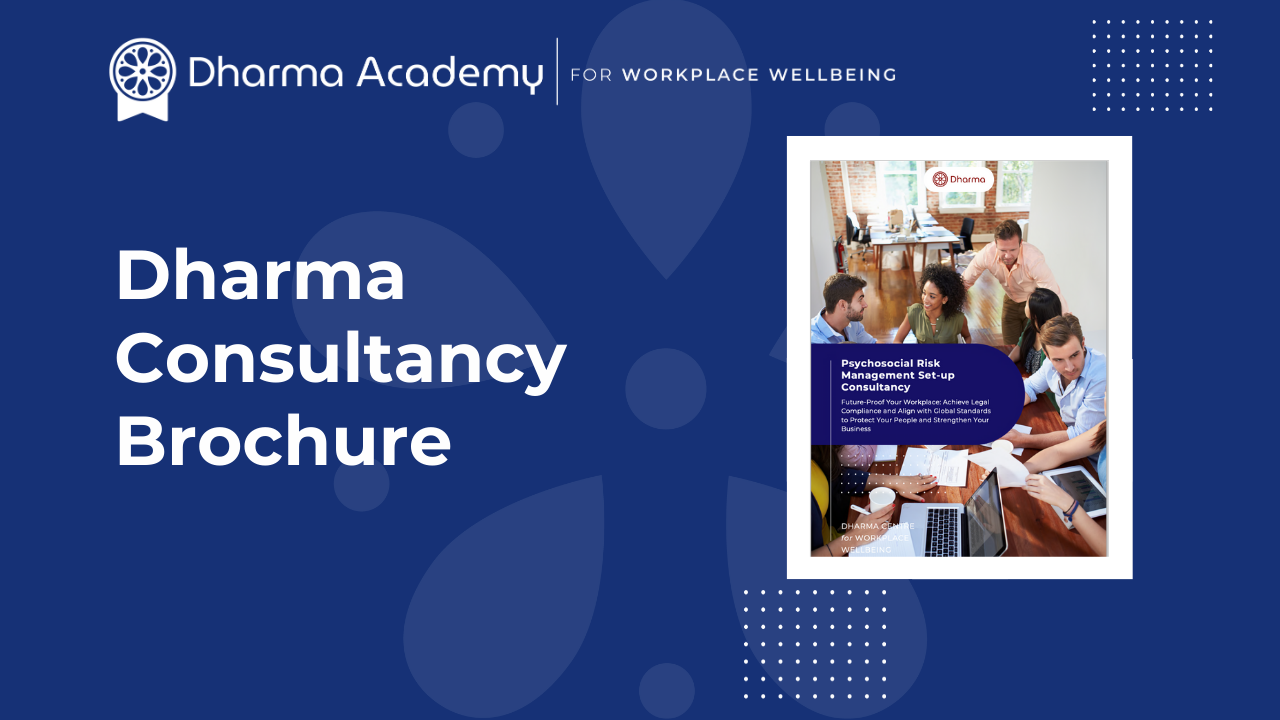
Learn about the support Dharma provides throughout the process of assessing psychosocial risks at your organisation
The 14 Psychosocial Risks
Learn about the 14 psychosocial risks assessed and how they impact workers and organisations when unmanaged
What exactly is a psychosocial risk assessment?
A psychosocial risk assessment is a structured, systematic process used to identify, assess, and manage work-related factors that may cause psychological harm.
It focuses on how work is designed, organised, managed, and experienced, examining factors such as workload, role clarity, leadership practices, working time, interpersonal relationships, and organisational change. These factors can create risk or protection depending on how they are managed.
Like any other workplace risk assessment, it involves:
Importantly, a psychosocial risk assessment is not a mental health screening exercise and does not assess individuals. It looks at systems, structures, and management practices, providing actionable insight into where changes to work design or management can reduce risk and improve wellbeing.
It applies the same health and safety principles used for physical risks to psychological health at work, helping organisations meet their duty of care in a structured and defensible way
What is the difference between a stress risk assessment and a psychosocial risk assessment?
A stress risk assessment typically focuses on work-related stress and is often limited to identifying stressors that may contribute to stress-related ill health.
A psychosocial risk assessment is broader and more comprehensive. It looks at the full range of work-related psychosocial factors that can affect psychological health, wellbeing, and performance, not just stress.
Key differences include:
Scope: Stress risk assessments focus primarily on stress. Psychosocial risk assessments examine how work is designed, organised, and managed, including workload, leadership, role clarity, working time, relationships, change, recognition, and communication.
Purpose: Stress risk assessments often identify areas of concern. Psychosocial risk assessments are designed to assess risk, prioritise hazards, and support preventative, system-level controls.
Alignment with standards: Psychosocial risk assessments align more closely with modern regulatory expectations and international standards such as ISO 45003.
In practice, stress is often an outcome of unmanaged psychosocial risks. A psychosocial risk assessment addresses the causes, rather than focusing only on one of the symptoms.
What types of risks does the assessment cover?
The assessment covers work-related psychosocial risks, the aspects of how work is designed, organised, managed, and experienced that can cause psychological harm or, when managed well, provide protection.
These risks typically include factors such as:
Work Content: The nature of the tasks people perform, including variety, meaning, complexity, and emotional demands of the work itself.
Workload & Pace: The amount of work employees are expected to complete and the speed or intensity at which it must be done.
Working Time: How working hours are organised, including length of shifts, overtime, breaks, and predictability of schedules.
Participation & Control: The degree to which employees can influence decisions about their work, how tasks are carried out, and changes that affect them.
Role Clarity & Responsibility: How clearly employees understand their role, responsibilities, priorities, and what is expected of them.
Professional Development: Access to learning, skill development, career progression, and opportunities to grow within the organisation.
Interpersonal Relationships: The quality of day-to-day interactions at work, including respect, support, conflict, bullying, or harassment.
Team Dynamics: How effectively teams work together, including trust, collaboration, communication, and shared accountability.
Mental Workload: The cognitive demands of the job, such as concentration, decision-making, problem-solving, and information processing.
Work–Life Balance: The extent to which work allows adequate time and energy for rest, recovery, and life outside of work.
Leadership Style: How leaders manage, communicate, support, and set expectations, including consistency, fairness, and approachability.
Response to Change: How organisational changes are planned, communicated, and managed, and how supported employees feel during periods of change.
Social Recognition: The extent to which effort, contribution, and achievements are acknowledged and valued by the organisation.
Information & Transparency: How clearly, consistently, and honestly information is shared, including communication about decisions, expectations, and organisational direction.
The assessment focuses on systemic and organisational factors, not individual resilience, personality, or medical conditions. It identifies where the design and management of work may be creating unnecessary risk and where controls or improvements are required.
These risk areas align with recognised regulatory expectations and international standards, ensuring the assessment produces actionable insights that can be translated into proportionate control measures and integrated into existing health and safety management systems.
What are the legal consequences of not implementing a psychosocial risk assessment in my organisation?
Failing to identify and manage psychosocial risks can expose an organisation to serious legal, regulatory, financial, and reputational consequences, particularly where psychological harm is linked to work.
In many countries, employers have a legal duty of care to protect employees’ psychological health. Where organisations cannot demonstrate that psychosocial risks have been identified, assessed, and reasonably managed, regulators may take enforcement action, and organisations may face civil claims or sanctions.
In the UK, this duty is clearly established under health and safety legislation. If an organisation fails to manage psychosocial risks appropriately:
Importantly, regulators do not expect organisations to eliminate all psychosocial risk. However, they do expect clear evidence of a structured, proportionate, and proactive approach to risk management. A documented psychosocial risk assessment is a key part of demonstrating due diligence and meeting legal obligations.
Without this evidence, organisations are significantly more exposed during inspections, investigations, or legal proceedings.
How does this assessment support regulatory inspections or audits?
The psychosocial risk assessment provides clear, documented evidence that your organisation is identifying, assessing, and managing psychosocial risks in a structured and proportionate way.
During inspections or audits, regulators typically look for evidence that:
This assessment supports that by producing:
Rather than relying on informal wellbeing initiatives or ad-hoc surveys, the assessment demonstrates that psychosocial risks are being managed with the same rigour as physical risks and are embedded within your existing health and safety management system.
It helps you move from “we care about wellbeing” to “we can evidence how we manage psychosocial risk”, which is exactly what regulators and auditors expect to see.
Should a psychosocial risk assessment be led by Health & Safety or by HR?
Psychosocial risk assessment sits at the intersection of Health & Safety and HR, and responsibility should be shared between both functions.
From a governance perspective, Health & Safety brings the risk management discipline, ensuring psychosocial risks are identified, assessed, documented, and reviewed in line with legal and regulatory expectations. This includes applying the same structured approach used for physical hazards and ensuring defensible evidence of compliance.
HR plays a critical role because many psychosocial risks are shaped by people processes, leadership practices, job design, performance management, and organisational culture. HR insight is essential to interpreting findings accurately and translating them into practical, sustainable interventions.
When both functions work together:
Psychosocial risk assessment requires Health & Safety rigour and HR capability. Treating it as the responsibility of only one function risks either weakening compliance or limiting meaningful change.
Do we need to repeat the assessment regularly?
Yes. Psychosocial risk assessments must be reviewed and repeated periodically, and this is a legal requirement, not a one-off exercise.
As with any workplace risk assessment, employers are required to ensure that risks to health and safety, including psychological health, remain up to date and effectively managed. This means reviewing the assessment:
In the UK, health and safety legislation requires employers to keep risk assessments current and relevant. Similar expectations exist internationally, reinforced through occupational health and safety frameworks and recognised standards such as ISO 45003.
Regular review ensures that control measures remain effective, emerging risks are identified early, and organisations can demonstrate ongoing due diligence rather than reactive compliance.
Repeating the assessment is part of good governance and legal compliance, not an optional extra.
Is the assessment anonymous?
Yes. The psychosocial risk assessment is designed to protect anonymity.
Employee input is collected and analysed at group or organisational level, not at an individual level. Responses are aggregated so that no individual can be identified, and results are reported only where there is a sufficient number of responses to preserve confidentiality.
The purpose of the assessment is to identify patterns and systemic risks in how work is designed and managed, not to assess individual performance or personal circumstances.
Maintaining anonymity is essential for both data integrity and trust, and it helps ensure honest, meaningful responses that lead to accurate and actionable insights.
How long does it take for a worker to complete the assessment?
The assessment is designed to be concise and focused. For most respondents, it typically takes around 10–15 minutes to complete.
The questions are targeted specifically at recognised psychosocial risk factors, avoiding unnecessary or repetitive items. This helps minimise burden on employees while still generating precise, actionable data.
Keeping completion time short supports higher participation rates and better-quality responses, without compromising the rigour of the assessment.
How long does a psychosocial risk assessment take (overall process)?
The timeframe depends on the size, structure, and complexity of the organisation, but most psychosocial risk assessments are completed within a defined, time-bound process rather than as an open-ended exercise.
Typically:
For many organisations, the full process, from launch to final report, can be completed in 4 weeks, without disrupting day-to-day operations.
Does the report provide segmentation of my choosing?
Yes. Segmentation is highly customisable and can be tailored to your organisation’s specific needs, priorities, and structure.
The assessment allows you to define segmentation criteria in advance so the results reflect what is most meaningful for your decision-making. This may include departments, functions, locations, role types, seniority levels, working patterns, or other relevant groupings.
Custom segmentation helps you:
To ensure confidentiality and data integrity, segmentation is applied only where there is a sufficient number of responses in each group. This protects anonymity while ensuring the data remains reliable and defensible.
Segmentation is flexible by design, shaped around your operational reality, not a fixed reporting template.
Does the assessment allow for benchmarking against other organisations?
Yes. The assessment allows for sector-specific benchmarking, so your results can be compared against organisations operating in the same industry or sector.
This helps you:
Benchmarking is conducted using aggregated, anonymised data to ensure confidentiality and fair comparison. It is designed to provide insight and perspective rather than create league tables or one-size-fits-all targets.
Used alongside internal segmentation and trend analysis, sector benchmarking supports better-informed, evidence-based decisions about where to focus effort and resources.
What happens after the assessment is completed?
Once the psychosocial risk assessment is completed, the focus shifts from diagnosis to action and governance.
You receive a clear, evidence-based report that:
The results are then used to:
The assessment also establishes a baseline, allowing organisations to monitor progress over time and review the effectiveness of control measures.
To help you understand what the output looks like in practice, you can download a sample psychosocial risk assessment report from the Resources section on this page.
The assessment does not end with a report, it creates a structured pathway from insight to action, aligned with legal and best-practice expectations.
Will the results of the assessment create expectations we cannot meet?
No, provided the assessment is positioned and used correctly.
The purpose of a psychosocial risk assessment is not to commit the organisation to solving every issue identified. It is to identify, assess, and prioritise risks, so that reasonable and proportionate action can be taken based on evidence.
Risk assessment results support:
From a legal and regulatory perspective, organisations are expected to demonstrate due diligence, not perfection. Having documented evidence of identified risks, risk ratings, and planned control measures strengthens governance and defensibility, even where constraints mean not all issues can be addressed at once.
When findings are communicated clearly, with emphasis on prioritisation and proportional action, the results create clarity rather than unrealistic expectations.
What if the results highlight serious issues?
That is precisely the value of conducting a psychosocial risk assessment.
Identifying serious issues early allows organisations to take informed, proportionate action before problems escalate into sickness absence, grievances, regulatory intervention, or legal exposure. The assessment provides evidence to prioritise risks based on severity and impact, rather than reacting to isolated incidents or assumptions.
Importantly, highlighting serious issues does not create an expectation to fix everything immediately. It enables organisations to:
From a regulatory perspective, it is far more defensible to have identified risks and be actively managing them than to be unaware of them or unable to evidence any action.
Difficult findings are not a failure, they are a starting point for prevention, prioritisation, and improvement.
How will this assessment help reduce absenteeism in my business?
Absenteeism is often a symptom of underlying work-related issues, not an isolated problem. Common drivers include sustained workload pressure, poor role clarity, ineffective management practices, lack of control, and poorly managed change.
A psychosocial risk assessment helps reduce absenteeism by:
Rather than reacting once absence levels rise, the assessment enables organisations to intervene earlier, addressing the root causes that contribute to stress-related absence.
Over time, organisations that use psychosocial risk assessments to improve how work is designed and managed typically see:
By improving the conditions in which people work, the assessment helps prevent avoidable absence rather than simply managing its consequences.
Is it very expensive to conduct this assessment?
No. In practice, a psychosocial risk assessment is modest in cost compared to the risks and costs it helps prevent.
The investment is typically small when set against:
Because the assessment is structured, time-bound, and focused on gathering precise, actionable data, it avoids the inefficiency and cost of unfocused wellbeing initiatives or repeated engagement surveys with limited impact.
More importantly, the assessment helps organisations prioritise action, ensuring resources are spent where they will have the greatest effect, rather than spread thinly across multiple initiatives.
In short, the question is rarely whether organisations can afford to conduct a psychosocial risk assessment, but whether they can afford not to.
Is there special pricing for non-profits, charities, or charitable organisations?
Yes. We recognise that non-profits, charities, and other mission-driven organisations often operate with tighter budgets while facing significant psychosocial risks.
We offer preferential pricing for eligible organisations in these sectors, designed to make psychosocial risk assessment accessible without compromising quality or rigour.
If you are a non-profit, charity, or charitable organisation, please get in touch to discuss your needs and eligibility, and we will explore the most appropriate and cost-effective option for your organisation.
How does this psychosocial risk assessment align with existing health and safety management systems?
Psychosocial risk assessment aligns directly with established health and safety management systems and uses the same risk management principles applied to physical hazards.
It fits naturally within existing frameworks by:
The assessment can be integrated into current policies, risk registers, and review cycles without creating parallel systems. It complements existing processes such as incident reporting, audits, management reviews, and continuous improvement activities.
In organisations operating formal management systems (for example, those aligned with international standards), psychosocial risk assessment strengthens the system by ensuring psychological health is managed with the same rigour as physical safety.
In short, it enhances what is already in place rather than replacing it, helping create a more complete and defensible approach to workplace risk management.
How can a psychosocial risk assessment enhance my current portfolio of risk assessment services?
A psychosocial risk assessment complements and strengthens your existing risk assessment portfolio by extending it into an area that is already covered by employers’ legal duty of care but often under-served. It allows you to offer a more complete, integrated view of workplace risk, addressing not only physical, chemical, and ergonomic hazards, but also work-related psychological risks.
By adding psychosocial risk assessment to your services, you:
Rather than replacing existing assessments, psychosocial risk assessment enhances them by addressing the organisational and work-design factors that often sit behind recurring incidents, absence, and performance issues.
I already use the HSE Management Standards Indicator Tool. Why should I use Dharma’s psychosocial risk assessment tool?
The HSE Management Standards Indicator Tool is a valuable starting point and has helped many organisations begin to explore work-related stress. However, it was designed primarily as a screening and benchmarking tool, not as a comprehensive psychosocial risk assessment aligned with current best practice and international standards.
Dharma’s psychosocial risk assessment builds on this foundation by:
While the HSE tool helps you identify areas of concern, Dharma’s assessment helps you understand the underlying organisational factors, assess risk more robustly, and take proportionate, evidence-based action.
Many organisations use both, starting with familiar tools, then moving to a more comprehensive assessment to strengthen their duty of care and risk management maturity.
Is this assessment compliant with ISO 45003?
The psychosocial risk assessment is aligned with the principles and requirements of ISO 45003, the international standard for managing psychological health and safety at work.
ISO 45003 does not prescribe a single tool or survey. Instead, it sets out expectations for how organisations should identify psychosocial hazards, assess risks, implement control measures, and review effectiveness as part of a wider occupational health and safety management system.
This assessment supports ISO 45003 alignment by:
When used as part of a broader management approach, the assessment provides organisations with a practical and defensible way to demonstrate alignment with ISO 45003 expectations.
How will this assessment help reduce voluntary employee turnover?
Voluntary turnover is rarely caused by a single issue. It is usually the result of persistent, work-related factors such as unmanaged workload, poor leadership practices, lack of role clarity, limited development opportunities, or ineffective handling of change.
A psychosocial risk assessment helps reduce voluntary turnover by:
Rather than relying on exit interviews or assumptions after people have already left, the assessment allows organisations to intervene earlier, addressing the root causes that influence employees’ decisions to stay or leave.
Over time, organisations that use psychosocial risk assessments to improve how work is designed and managed typically see:
In short, by improving the conditions in which people work, the assessment supports retention through prevention, not reactive fixes.
How will this assessment help improve engagement?
Employee engagement is strongly influenced by how work is designed, managed, and experienced. A psychosocial risk assessment helps improve engagement by identifying the work-related factors that either enable or undermine it.
The assessment provides insight into areas such as workload balance, role clarity, leadership practices, participation, recognition, and communication, all of which are core drivers of engagement.
By using the results to:
Unlike engagement surveys alone, which describe how people feel, a psychosocial risk assessment helps organisations understand why they feel that way and what needs to change. When employees see that feedback leads to tangible improvements, confidence and engagement typically increase over time.
The assessment improves engagement by improving the quality of the work environment, not by adding another engagement initiative.
We already run employee engagement surveys. Isn’t that the same as a psychosocial risk assessment?
Employee engagement surveys and psychosocial risk assessments serve different but complementary purposes.
Engagement surveys are designed to capture how employees feel at a particular point in time, for example, levels of motivation, satisfaction, or commitment. They are valuable for tracking sentiment and trends, but they do not assess risk in the health and safety sense.
A psychosocial risk assessment focuses on identifying and evaluating work-related factors that may cause psychological harm, such as workload design, role clarity, management practices, control, and organisational change. It examines the conditions of work that create risk or protection, rather than perceptions alone.
In simple terms:
Organisations that rely solely on engagement data may see warning signs but lack the structured insight needed to take proportionate, defensible action. A psychosocial risk assessment provides that structure, helping translate engagement findings into clear risk controls and preventative measures.
Many organisations use engagement surveys alongside psychosocial risk assessments to gain both insight and assurance.
How will this assessment help reduce absenteeism in my business?
Absenteeism is often a symptom of underlying work-related issues, not an isolated problem. Common drivers include sustained workload pressure, poor role clarity, ineffective management practices, lack of control, and poorly managed change.
A psychosocial risk assessment helps reduce absenteeism by:
Rather than reacting once absence levels rise, the assessment enables organisations to intervene earlier, addressing the root causes that contribute to stress-related absence.
Over time, organisations that use psychosocial risk assessments to improve how work is designed and managed typically see:
By improving the conditions in which people work, the assessment helps prevent avoidable absence rather than simply managing its consequences.
Our employees are experiencing survey fatigue. Is there another way to conduct psychosocial risk assessments without surveys?
If the goal is to obtain precise, defensible, and actionable data, then structured employee input through surveys is essential.
Psychosocial risks relate to how work is experienced. While organisational data and qualitative insights can provide useful context, they cannot replace systematically collected employee data when it comes to accurately identifying risk levels, prioritising hazards, and determining where action is genuinely required.
A well-designed psychosocial risk assessment survey:
Survey fatigue is often a symptom of poorly designed or unfocused surveys, not of the assessment itself. When employees understand that the data will lead to tangible changes in how work is designed and managed, participation and data quality improve significantly.
If organisations want reliable insight that leads to targeted action, not assumptions, structured employee surveys remain the most effective and credible method.
Book a 1:1 call with us to explore how running a psychosocial risk assessment can benefit your organisation

Book a call with Laura today to learn how managing psychosocial risks are an essential component of employers' legal duty of care in the UK.

Book a call with Dharma's Founder and Managing Director to gain expert insight into managing psychosocial risks at your organisation.